Tuesday, April 24, 2012

Offended: Wrong teaching about overcoming sin


Practice makes perfect. This wise old saying is, in most cases, true. One wants to play and musical instrument or sing then hours or preparation are in order. Doctors, after years doing the job, are more apt to diagnose correctly. And the list goes on in efforts on this planet where practice pays off. When it comes to sin which so easily entraps us this is not the case. One can curb sin of action by resisting the temptation. In addition the sin of omission will be curbed by doing what is right when it presents itself to be done. However, what about the sin of the thought life based squarely in the mind and heart.

Romans 7:21 So I find it to be a law that when I want to do right, evil lies close at hand. 22 For I delight in the law of God, in my inner being, 23 but I see in my members another law waging war against the law of my mind and making me captive to the law of sin that dwells in my members. 24 Wretched man that I am! Who will deliver me from this body of death? ESV 

Reason would look at that question and she would suggest to try harder. This is the natural answer to many of the challenges we face in life. The answer, sadly, in much of the Christian Church is casting the sinner back on him or her selves. This is pagan Greek philosophy but in no way Christianity. Where does St Paul point us?

Romans 7:25 Thanks be to God through Jesus Christ our Lord! So then, I myself serve the law of God with my mind, but with my flesh I serve the law of sin. ESV


Romans 8: There is therefore now no condemnation for those who are in Christ Jesus. 2 For the law of the Spirit of life has set you free in Christ Jesus from the law of sin and death. ESV

What human reason and effort cannot do Jesus did for us by his holy life, bitter sufferings, death and resurrection. This handled the curse of the law for us. Do we want to sin and keep on sinning. No. But out of true repentance we look to Christ and trust his doing the whole job for us. Let us trust this good news and live in the peace it gives.

In the name of Jesus. Amen †

Sunday, April 8, 2012

Offense: God is Angry With You!

This error is based mostly on assuming the behaviour of the Christian is related to justification. We all fall short in our thoughts words and deeds in trying to do what our Heavenly Father desires of men. This error is preached, it seems, to guilt the believer into either changing behaviour and perhaps increase service in the church. This hurts people who are sensitive to the law and loves Jesus that he or she would wish to follow perfectly. However, is God really angry with us for our failures to follow his commands and desires for our lives? 


 Colossians 1: 21 And you, who once were alienated and hostile in mind,doing evil deeds, 22 he has now reconciled in his body of flesh by his death, in order to present you holy and blameless and above reproach before him, 23 if indeed you continue in the faith, stable and steadfast, not shifting from the hope of the gospel that you heard, which has been proclaimed in all creation under heaven, and of which I, Paul, became a minister. ESV 


 In this letter to the Colossian congregation on will see that we are reconciled with God by the death of Jesus for our sins. We are also by virtue of the innocent and bitter suffering and death of our shepherd presented holy and blameless. This should answer once and for all the fear that God is angry with us and will reject us or we are not truly saved due to our falling short. 


One can be so hurt by this wretched error that one can lose faith in Jesus. One may err from the faith and adopt a "why bother trying since my trying is or was a failure?" This hopelessness often leaves one erring from the faith rather than keeping in repentance and true faith in Christ.


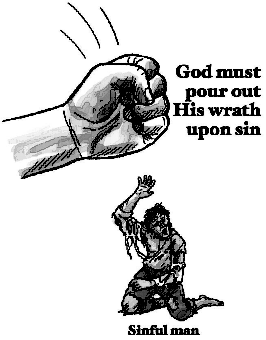
This error is not beholding the bitter suffering and death of Jesus in a correct manner. A true view will see God's fierce wrath toward sins as well as how that Jesus bore this wrath for all people. Hence the teaching of God being angry towards a believer is an actual slap in the face to the Crucified Lamb of God. When one has been granted repentance and faith in the finished work of Christ God is no longer angry with the believer. And the grateful response of the Christian is to out of gratitude seek to guard the words of Jesus seeing them as a Light unto his or her path. 


Let us trust this good news and live in the peace it gives. 


In the name of Jesus. Amen. †

Monday, February 13, 2012

OFFENDED!!!!!!!!!!!!!!!!!!!!

Offence will happen when sinners rub shoulders with other sinners. The theme to my new blog is an examining how that happens and good news for those who may offend other Christians. http://fivepintlutheran2.wordpress.com/ This is the address. I do not have 10 ways to overcome offenses but have spoke with many offended Christians. Some of these offended Christians will not attend worship or even fall into unbelief. Good news is that Jesus offended without sin and this is credited to us through faith. His holy life,his innocent suffering under the wrath of God and his glorious resurrection we have forgiveness. Let us trust this good news and strive to live in it. In the name of Jesus. Amen. †

Tuesday, November 1, 2011

Too Good to be True


In conversing with other believers one will find a common misconception about our Heavenly Father. So many will state something to the effect that God is still angry with people over sin. This is taught to people either directly or indirectly. From pietistic rules such as you better come to church at least 3 times a week to this terrible thing happened because you did something wrong. Rather than tell others of the good news people make God out to be the one with the problem.

All this is from God, who through Christ reconciled us to himself and gave us the ministry of reconciliation; that is, in Christ God was reconciling the world to himself, not counting their trespasses against them, and entrusting to us the message of reconciliation. (2 Corinthians 5:18-19 ESV)

In this section St Paul makes a bold statement which seems too good to be true. Christ’s finished work on the cross and rising from the dead has reconciled all people to God. This is so hard to swallow that many object to it no matter the Theological bend which has grabbed them. To combat this bend we see St Paul continue:

Therefore, we are ambassadors for Christ, God making his appeal through us. We implore you on behalf of Christ, be reconciled to God. For our sake he made him to be sin who knew no sin, so that in him we might become the righteousness of God. (2 Corinthians 5:20-21 ESV)

Aha so God is not the one with the problem but rather the sinners who have it against God who will not reconcile. This makes perdition all the worse for it is not the falling short of God that damns but the stubborn refusal to trust in Jesus’ provision. It is so unnecessary for one to spend eternity apart from the goodness and joy of our Creator.

Let us therefore, believe this good news and live in the peace that it gives. In the name of Jesus. Amen. †

Monday, October 24, 2011

Chrysostom on Justification by Faith Alone


More wholesome teaching from John Chrysostom, here expounding Acts ch. 15:


“But there rose up certain of the sect of the Pharisees which believed, saying, That it was needful to circumcise them, and to command them to keep the law of Moses. And the apostles and elders came together to consider of this matter. And when there had been much disputing, Peter rose up and said unto them, Men and brethren, ye know how that of old days God made choice among us, that the Gentiles by my mouth should hear the word of the Gospel, and believe.” (v. 5–7.) Observe Peter from the first standing aloof (κεχωρισμένον) from the affair, and even to this time Judaizing. And yet (says he) “ye know.” (ch. x. 45; xi. 2.) Perhaps those were present who of old found fault with him in the matter of Cornelius, and went in with him (on that occasion): for this reason he brings them forward as witnesses. “From old days,” he says, “did choose among you.” What means, “Among you?” Either, in Palestine, or, you being present. “By my mouth.” Observe how he shows that it was God speaking by him, and no human utterance. “And God, that knoweth the hearts, gave testimony unto them:” he refers them to the spiritual testimony: “by giving them the Holy Ghost even as unto us.” (v. 8.) Everywhere he puts the Gentiles upon a thorough equality. “And put no difference between us and them, having purified their hearts by faith.” (v. 9.) From faith alone, he says, they obtained the same gifts. This is also meant as a lesson to those (objectors); this is able to teach even them that faith only is needed, not works nor circumcision. For indeed they do not say all this only by way of apology for the Gentiles, but to teach (the Jewish believers) also to abandon the Law. However, at present this is not said. “Now therefore why tempt ye God, to put a yoke upon the neck of the disciples?” (v. 10.) What means, “Tempt ye God?” As if He had not power to save by faith. Consequently, it proceeds from a want of faith, this bringing in the Law. Then he shows that they themselves were nothing benefited by it, and he turns the whole (stress of his speech) against the Law, not against them, and (so) cuts short the accusation of them: “which neither our fathers nor we were able to bear. But we believe that through the grace of the Lord Jesus we shall be saved, even as they.” (v. 11.) How full of power these words! The same that Paul says at large in the Epistle to the Romans, the same says Peter here. “For if Abraham,” says (Paul), “was justified by works, he hath whereof to glory, but not before God.”
John Chrysostom, Homilies on the Acts of the Apostles, NPNF1: Vol. XIII, A Commentary on the Acts of the Apostles, Homily 32 on Acts 15:1 [italics mine]

--+--

I just read on an Eastern Orthodox blog that justification by faith alone is a 'Protestant heresy'. That may well be a justifiable (sic!) Orthodox view if one is guided by post-Reformation Orthodox polemics on the subject...but then, what to do with statements like this from one of the Fathers whom Orthodoxy most reveres? The only solution would appear to be a doctrine of 'double justification', initially by faith and subsequently by works (not unknown in the West, either!). Among the Orthodox, this position is usually accompanied by a polemic against the 'overly juridical' bent of 'Western theology' since Augustine which Luther subsequently inherited (a curious view, since Augustine certainly did not hold to a juridical/forensic doctrine of justification). Here's an example from a modern Orthodox theologian:
'In summary, it is not an antagonistic attitude that causes the eastern Christian and patristic scholar to recoil at some notions of western and Protestant theology, it is simply that the approach employed by many western scholars (inherited from the likes of Augustine, Anselm and Luther) seems at odds with what eastern Christians believe has been safeguarded since the foundation of the Church at Pentecost. The traditional Orthodox mind is immediately suspicious of biblical interpretations that have little or no root in the early life and theology of the Church; this is true in spades of particularly the forensic notion of justification, and of its consequent bifurcation of faith and works... Because of its less juridical exegesis of Pauline soteriological statements, Eastern Christianity has never had anything approaching the kind of faith v. works controversies that have enveloped and (for both good and ill) theologically shaped the Christian West... Rather, the East has maintained a somewhat distant and even puzzled attitude toward the theological polemics which have raged over justification in terms of faith or works.'
Valerie Karras, in Justification and the Future of the Ecumenical Movement (Liturgical Press – Collegeville, MN)

It is certainly true, as Dr Karras maintains, that Orthodox theology and doctrine followed quite a different trajectory from that of the Western church - to the extent, that is, that the latter has been guided by Augustine's anti-Pelagianism. To my mind Orthodox theology represents a development of the theology of the early semi-Pelagian ascetics, some of whom brought monasticism from the East to southern Gaul (see the life and influence of John Cassian, seminal to the development of monasticism in both East and West). The West officially rejected the theology of this movement at the 2nd Council of Orange (529AD), although its influence was never expunged, principally due to the rise and rise of monasticism into the Middle Ages courtesy the Benedictine movement and its offshoots.

Tellingly, the Christian East has never rejected semi-Pelagianism; from that perspective the centrality of disputes about justification and works in Western theology over the last 500 years must indeed seem inexplicable. But can it really be said that justification by faith alone 'has little or no root in the early life and theology of the Church'!? Granted, the full exposition of the Biblical doctrine had to await the Lutheran Reformation, but there is ample evidence that the Fathers who closely expounded the New Testament in their homilies knew the doctrine. The problem is that they never succeeded in integrating it into their theology of the Christian life as a whole (for various reasons which we might explore in further posts on the subject). That task that was God-given to Blessed Martin Luther, Melanchthon, Martin Chemnitz and other luminaries of the Lutheran Reformation. SDG!

Thank you to Pr Mark Henderson over at Lutheran Catholicity blog for allowing this repost.

Monday, September 12, 2011

WDJM - What Did Jesus Mean?


Matthew 13:44 The kingdom of heaven is like treasure hidden in a field, which a man found and covered up. Then in his joy he goes and sells all that he has and buys that field. ESV

I have listened to sermons on the above passage. In some of the sermons the treasure hidden in the field is you and me. Jesus is the sacrificial purchaser of this treasure which of course he did by shedding his blood on the cross.

Yet another approach was to present it as Jesus being the treasure. Not that we sell all we have to purchase the field but as a demonstration of incalculable worth this salvation is to each and every one of us.

Still another view was that salvation is to be gained by our sacrificial living and being willing to leave all we have to obtain this treasure.

Which one or more do you think is the most accurate understanding(s) of this passage? Why do you think it is the best understanding? Or have you another understanding which you think is better?


Friday, June 17, 2011

Of hats and hair.


Matthew 23:1 Then Jesus said to the crowds and to his disciples, 2 “The scribes and the Pharisees sit on Moses' seat, 3 so practice and observe whatever they tell you—but not what they do. For they preach, but do not practice. 4 They tie up heavy burdens, hard to bear, and lay them on people's shoulders, but they themselves are not willing to move them with their finger. ESV

The other day I heard a preacher say that he is going to start church discipline against women who do not wear head coverings or men with long hair. It was his opinion since it was an apostolic command it should be adhered to and to not do it would damage the person.

1 Corinthians 11:2 Now I commend you because you remember me in everything and maintain the traditions even as I delivered them to you. 3 But I want you to understand that the head of every man is Christ, the head of a wife is her husband, and the head of Christ is God. 4 Every man who prays or prophesies with his head covered dishonors his head, 5 but every wife who prays or prophesies with her head uncovered dishonors her head, since it is the same as if her head were shaven. 6 For if a wife will not cover her head, then she should cut her hair short. But since it is disgraceful for a wife to cut off her hair or shave her head, let her cover her head. 7 For a man ought not to cover his head, since he is the image and glory of God, but woman is the glory of man. 8 For man was not made from woman, but woman from man. 9 Neither was man created for woman, but woman for man. 10 That is why a wife ought to have a symbol of authority on her head, because of the angels. 11 Nevertheless, in the Lord woman is not independent of man nor man of woman; 12 for as woman was made from man, so man is now born of woman. And all things are from God. 13 Judge for yourselves: is it proper for a wife to pray to God with her head uncovered? 14 Does not nature itself teach you that if a man wears long hair it is a disgrace for him, 15 but if a woman has long hair, it is her glory? For her hair is given to her for a covering. ESV

The above passage is used to insist that women cover the head while in church. This was customary in all churches years ago. Since it is not customary in some churches it would be incorrect to discipline women who do not cover the head. This is inventing a weight or a law for her to bear which is outside of scripture. In this way one resembles the Pharisees of Jesus’ day which is something he does not tolerate. A better use of a pastor’s time is to do what Jesus says and tell people their sins are forgiven. John 20:23

1 Corinthians 11:16 If anyone is inclined to be contentious, we have no such practice, nor do the churches of God. ESV

This verse seems to toss it all out the window about long hair on men and head coverings for women to place him or her under bondage. A pastor’s time would be better spent working to increase in his flock more trust in the finished work of Jesus on the cross. In that way he would encourage to keep eyes on Jesus and to live in the peace that gives.

In the name of Jesus. Amen †